
A Plain-English Guide for New Jersey Families
Applied Behavior Analysis (ABA) is a therapy that teaches specific, practical skills by studying how a person learns — what happens before a behavior, and what happens after it. In practice that means building communication, daily living, social and safety skills, and reducing behaviors that get in the way of learning or put a child at risk.
A Board Certified Behavior Analyst (BCBA) assesses your child, writes an individualized plan with measurable goals, and adjusts it based on data collected in every session.
This page explains what that actually looks like — who delivers it, where it happens, what it costs, and what ABA is not. If you would rather just talk to someone, get in touch.

How ABA Therapy Works
Every program follows the same basic loop. What changes is the content — the goals, the teaching methods and the pace are built around the individual child.
- 1Assessment
- 2Individualized Goals
- 3Teaching
- 4Data Collection
- 5Review & Adjust
- 6Generalization
1. Assessment. A BCBA observes your child, talks with your family, and identifies strengths, needs and priorities.
2. Individualized goals. The BCBA writes specific, measurable goals — not “improve communication” but a defined skill that can be observed and counted.
3. Teaching. A behavior technician works one-to-one with your child, using structured practice and naturally occurring moments — play, routines, transitions.
4. Data collection. Progress on each goal is recorded session by session, so change is measured rather than assumed.
5. Review and adjust. The BCBA reviews the data, and changes goals or teaching strategies when something is not working.
6. Generalization. The skill is practised with different people, in different settings, until it holds up outside the session.
What ABA Therapy Can Help With
Goals are chosen for their effect on everyday life. These are the areas programs most often address:
Common Goal Areas
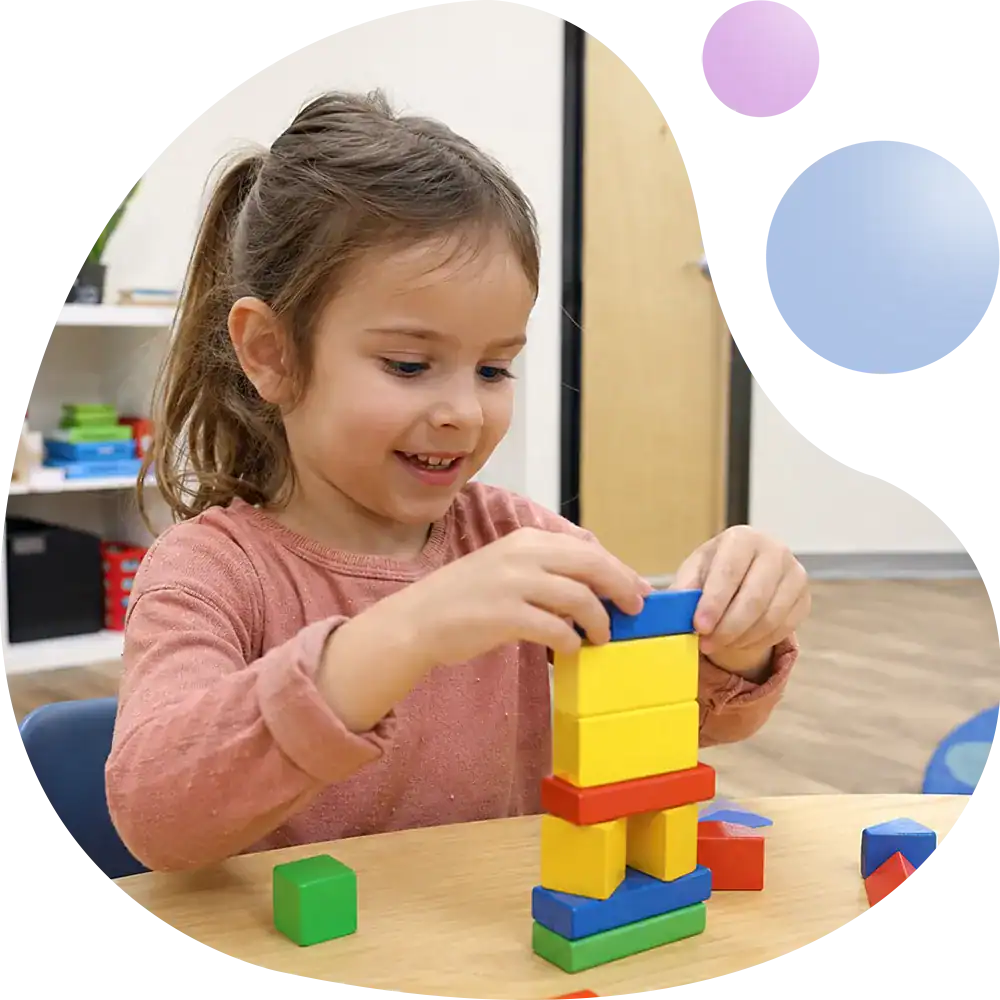
- Communication - Building a functional way to express wants, needs, feelings and choices — whether that is spoken language, an AAC device, signs or gestures.
- Daily Living & Independence - Dressing, hygiene, toileting, mealtimes, chores and the everyday routines that make family life work.
- Social & Play Skills - Joining in, taking turns, sharing, playing alongside and with other children, and building friendships.
- Behavior & Emotional Regulation - Navigating frustration, waiting, transitions and changes in routine, while reducing behaviors that interfere with safety or learning.
- Safety & Community Participation - Skills for getting through stores, appointments, playgrounds and other everyday environments safely and successfully.
- School Readiness - Following group directions, participating in activities, managing transitions and the other skills a classroom asks for.
- Generalization - Using a learned skill with different people, in different places, and long after the session that taught it — which is the point of the whole thing.
Where ABA Therapy Happens
The same clinical model can be delivered in different settings. The right one depends on your child’s goals.
In the homeWhere daily routines already happenMorning routines, homework, mealtimes, playing with siblings — taught where they occur.
At a centerFlanders & Augusta, NJA setting built for learning, with peers nearby for social, play and school-readiness skills.
At schoolDistricts & familiesBCBA consultation, functional behavior assessments and behavior intervention plans.
In a peer groupAges 3–10 • small groupsSmall social skills groups where children practise with other children, not just adults.
What ABA Therapy Is Not
Worth saying plainly, because the field has a history and families deserve straight answers.
Four Honest Clarifications

- It is not a cure, and it should not be sold as one. - Autism is not something ABA sets out to remove. The goal is to build skills that expand what a child can do and choose for themselves.
- It is not one-size-fits-all. - Two children with the same diagnosis can have completely different programs. If a plan looks generic, that is a reason to ask questions.
- It is not about compliance. - Modern practice is built around a child's motivation, assent and communication — not getting them to sit still. A child who can say “no” and be heard is a child whose communication is working.
- It is not the only support a child may need. - ABA often runs alongside speech therapy, occupational therapy, school services and medical care. A good provider coordinates rather than competes.
Common Questions About ABA Therapy
What does ABA stand for?
ABA stands for Applied Behavior Analysis. It is the applied branch of behavior analysis — the study of how learning and behavior are shaped by what happens before and after them, used to build skills that matter in everyday life.
Who is qualified to provide ABA therapy?
A Board Certified Behavior Analyst (BCBA) designs and oversees treatment. BCBA is a graduate-level certification issued by the Behavior Analyst Certification Board (BACB), which requires qualifying coursework, supervised fieldwork, a board examination, and ongoing continuing education to maintain.
Day-to-day sessions are typically delivered by a trained behavior technician — often a Registered Behavior Technician (RBT), a paraprofessional credential that works under BCBA supervision. The BCBA stays involved throughout, reviewing data and adjusting the plan.
It is entirely reasonable to ask a provider who holds which credential and how often the BCBA supervises sessions.
Does my child need an autism diagnosis to receive ABA therapy?
For insurance-funded ABA, a diagnosis is generally required, because coverage is written around medically necessary treatment for a diagnosed condition. Requirements vary by plan.
ABA is also used with children who have other developmental or behavioral needs. And some programs — such as our social skills groups — do not require a diagnosis at all.
The practical answer for your family depends on your plan. Ask us and we will help you work it out.
Is ABA therapy covered by insurance in New Jersey?
Often, yes — but it depends on what kind of plan you have, and this is the part most families are not told.
New Jersey's 2009 autism insurance mandate requires fully insured health plans regulated by the state to cover medically necessary applied behavior analysis, along with autism screening and diagnosis. That covers individual and family marketplace plans and employer plans issued in New Jersey.
It does not reach self-funded employer plans, which are governed by federal ERISA law rather than state mandates. Many large employers are self-funded. Those plans often cover ABA anyway, and federal mental health parity rules still apply, but the state mandate is not what compels it.
Our insurance page covers this in more detail, and we can verify your benefits with you.
At what age can a child start ABA therapy?
ABA is used across a wide age range, from toddlers through adolescence. Early intervention programs typically begin in the toddler and preschool years, while older children and teenagers work on very different goals — independence, self-advocacy, community skills and social communication.
There is no age at which learning a useful skill stops being worthwhile. The right question is not “is my child the right age” but “what would make the biggest difference for my child right now.”
How many hours a week does ABA therapy take?
It varies considerably, and it should. Recommended hours come out of your child's assessment and depend on their goals, age, school schedule and what your family can sustain.
Be cautious of any provider who quotes a number before assessing your child. A plan that ignores your family's actual life is a plan that will not survive contact with it.
How long before we see progress?
Meaningful change usually shows up gradually, and unevenly — a child may make quick gains in one area while another takes far longer.
What you should expect from the start is measurement. ABA programs collect data on specific, defined goals, which means progress is something you can be shown rather than something you have to take on faith. Ask to see it.
What is the difference between in-home and center-based ABA?
The setting, and what each setting makes possible. In-home ABA teaches skills inside the routines that already happen at home. Center-based ABA takes place at a clinic where other children are nearby, creating natural opportunities for social, play and group skills.
Many children do well in one. Some benefit from a combination. Your BCBA will recommend based on the assessment and your family's priorities.
Still Deciding?
Understanding ABA on paper is one thing. Working out whether it is right for your child is another, and you do not have to do it alone.
Tell us about your child and we will talk you through the options — including the ones that are not us.
TEAM — Together Everyone Achieves Miracles.
Get Started Read Our FAQExplore More
In-Home ABA TherapyABA in your own home and daily routines
Center-Based ABA TherapyTwo Northern New Jersey centers
School Support & ConsultationBCBA support for districts and families
Kidz Connect Social Skills GroupsSmall, age-banded social skills groups
Insurance & CoverageCarriers, verification and what to expect
Meet Our TEAMThe clinicians behind your child's care
Talk With Our Team
Have a question about your child, or wondering whether ABA therapy is the right fit?
Share a few details and someone from our team will reach out to talk it through with you.
Insurance Plans We Work With